/07/15 · ASCII '\0' appeared in the statement, but this is not allowed unless option --binary-mode is enabled and mysql is run in non-interactive mode From the manual on –binary-mode By default, ASCII ‘\0’ is disallowed and ‘\r\n’ is translated to ‘\n’.Estimated Reading Time: 5 mins The binary character set is the character set for binary strings, which are sequences of bytes. The binary character set has one collation, also named binary. Comparison and sorting are based on numeric byte values, rather than on numeric character code values (which This option was added in MySQL --binary-mode. This option helps when processing mysqlbinlog output that may contain BLOB values. By default, mysql translates \r\n in statement strings to \n and interprets \0 as the statement terminator
Binary options: Mysql binary option
Startup Options Used with Binary Logging. System Variables Used with Binary Logging. You can use the mysqld options and system variables that are described in this section to affect the operation of the binary log as well as to control which statements are written to the binary log.
For additional information about the binary log, see Section 5. For additional information about using MySQL server options and system variables, see Section 5. The following list describes startup options for enabling and configuring the binary log.
System variables used with binary logging are discussed later in this section. Mysql binary option row-based binary logging is used, this setting is a soft limit on the maximum size of a row-based binary log event, in bytes. Where possible, rows stored in the binary log are grouped into events with a size not exceeding the value of this setting. If an event cannot be split, the maximum size can be exceeded.
The value must be or else gets rounded down to a multiple of The default is bytes. Specifies the base name to use for binary log files.
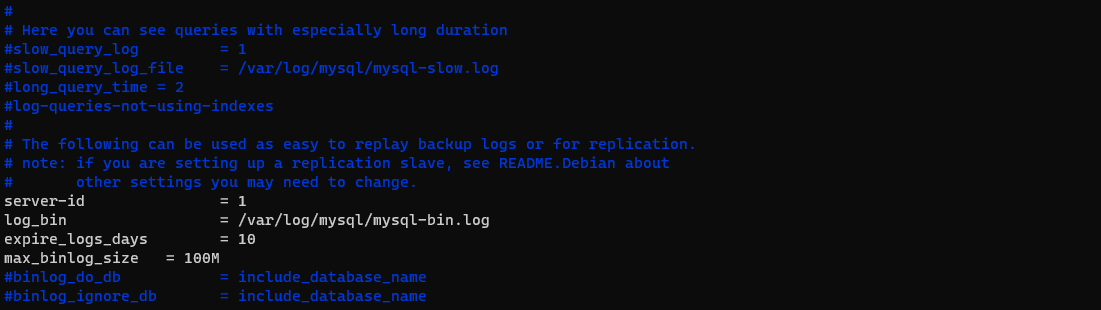
With binary logging enabled, the server logs all statements that change data to the binary log, which is used for backup and replication. The binary log is a sequence of files with a base name and numeric extension. The --log-bin option value is the base name for the log sequence. The server creates binary log files in sequence by adding a numeric suffix to the base name.
If you do not supply the --log-bin option, MySQL uses binlog as the default base name for the binary log files. The default location for binary log files is the data directory.
You can use the --log-bin option to specify an alternative location, by adding a leading absolute path name to the base name to specify a different directory.
When the server reads an entry from the binary log index file, which tracks the binary log files that have been used, it checks whether the entry contains a relative path. If it does, the relative part of the path is replaced with the absolute path set using the --log-bin option. An absolute path recorded in the binary log mysql binary option file remains unchanged; in such a case, mysql binary option, the index file must be edited manually to enable a new path or paths to be used.
In earlier MySQL versions, binary logging was disabled by default, and was enabled if you specified the --log-bin option. From MySQL 8, mysql binary option. The exception is if you use mysqld to initialize the data directory manually by invoking it with the --initialize or --initialize-insecure option, mysql binary option, when binary logging is disabled by default.
It is possible to enable binary logging in this case by specifying the --log-bin option. To disable binary logging, you can specify the --skip-log-bin or --disable-log-bin option at startup. If either of these options is specified and --log-bin is also specified, the option specified later takes precedence. When GTIDs are in use on the server, if you disable binary logging when restarting the server after an abnormal shutdown, some GTIDs are likely to be lost, causing replication to fail.
In a normal shutdown, the set of GTIDs from the current binary log file is saved in the mysql. Following an abnormal shutdown where this did not happen, during recovery the GTIDs are added to the table from the binary log file, provided that binary logging is still enabled. If binary logging is disabled for the mysql binary option restart, the server cannot access the binary log file to recover the GTIDs, so replication cannot be started.
Binary logging can be disabled safely after a normal shutdown. The --log-slave-updates and --slave-preserve-commit-order options require binary logging. MySQL disables these options by default when --skip-log-bin or --disable-log-bin is specified. If you specify --log-slave-updates or --slave-preserve-commit-order together with --skip-log-bin or --disable-log-bina warning or error message is issued.
In MySQL 5, mysql binary option. In MySQL 8. For servers that are used in a replication topology, mysql binary option, you must specify a unique nonzero server ID for each server. For information on the format and management of the binary log, see Section 5. The name for the binary log index file, which contains the names of the binary log files.
By default, it has the same location and base name as the value specified for the binary log files using the --log-bin option, plus the extension. If you do not specify --log-binthe default binary log index file name is binlog, mysql binary option.
indexusing the name of the host machine. Statement selection options. The options in the following list affect which statements are written to the binary log, and thus sent by a replication source server to its replicas. There are also options for replicas that control which statements received from the source should be executed or ignored. For details, mysql binary option, see Section This option affects binary logging in a manner similar to the way that --replicate-do-db affects replication.
The effects of this option depend on whether the statement-based or row-based logging format is in use, in the same way that the effects of --replicate-do-db depend on whether statement-based or row-based replication is in use. For example, DDL statements such as CREATE TABLE and ALTER TABLE are always logged as statements, without regard to the logging format in effect, so the following statement-based rules for --binlog-do-db always apply in determining whether or not the statement is logged, mysql binary option.
Statement-based logging. To specify multiple databases you must use multiple instances of this option. Because database names can contain commas, the list is treated as the name of a single database if you supply a comma-separated list. It is also faster to check only the default database rather than all databases if there is no need. Another case which may not be self-evident occurs when a given database is replicated even though it was not specified when setting the option.
Because sales is the default database when the UPDATE statement is issued, the UPDATE is logged. Row-based logging. The changes to the february table in the sales database are logged in accordance with the UPDATE statement; this occurs whether or not the USE statement was issued, mysql binary option. Even if the USE prices statement were changed to USE salesthe UPDATE statement's effects would still not be written to the binary log.
Another important difference in --binlog-do-db handling for statement-based logging as opposed to the row-based logging occurs with regard to statements that refer to multiple databases. If you are using statement-based logging, the updates to both tables are written to the binary log. However, when using the row-based format, only the changes to table1 are logged; table2 is in a different database, so it is not changed by the UPDATE, mysql binary option.
Now suppose that, instead of the USE db1 statement, a Mysql binary option db4 statement had been used:. In this case, the UPDATE statement is not written to the binary log when using statement-based logging.
However, when using row-based logging, the change to table1 is logged, mysql binary option, but not that to table2 —in other words, only changes to tables in the database mysql binary option by --binlog-do-db are logged, and the choice of default database has no effect on this behavior.
This option affects binary logging in a manner similar to the way that --replicate-ignore-db affects replication. The effects of this option depend on whether the statement-based or row-based logging format is in use, in the same way that the effects of --replicate-ignore-db depend on whether statement-based or row-based replication is in use. For example, DDL statements such as CREATE TABLE and Mysql binary option TABLE are always logged as statements, without regard to the logging format in effect, so the following statement-based rules for --binlog-ignore-db always apply in determining whether or not the statement is logged, mysql binary option.
When there is no default database, no --binlog-ignore-db options are applied, and such statements are always logged. BugBug Row-based format. The current database has no effect. When using statement-based logging, the following example does not work as you might expect. The UPDATE statement is logged in such a case because --binlog-ignore-db applies only to the default database determined by the USE statement.
Because the sales database was specified explicitly in the statement, the statement has not been filtered, mysql binary option. However, when using row-based logging, the UPDATE statement's effects are not written to the binary log, mysql binary option, which means that no changes to the sales. To specify more than one database to ignore, use this option multiple times, once for each database. You should not use this option if you mysql binary option using cross-database updates and you do not want these updates to be logged.
Checksum options. MySQL supports reading and writing of binary log checksums. These are enabled using the two options listed here:. Enabling this option causes the source to write checksums for events mysql binary option to the binary log. Set to NONE to disable, or the name of the algorithm to be used for generating checksums; currently, only CRC32 checksums are supported, and CRC32 is the default.
You cannot change the setting for this option within a mysql binary option. To control reading of checksums by the replica from the relay loguse the --slave-sql-verify-checksum option. Testing and debugging options. The following binary log options are used in replication testing and debugging. They are not intended for use in normal operations. This option is used internally by the MySQL test suite for replication testing and debugging.
The following list describes system variables for controlling binary logging. They can be set at server startup and some of them can be changed at runtime using SET.
Server options used to control binary logging are listed earlier in this section. The size of the memory buffer to hold changes to the binary log during a transaction. The value must be a multiple of If the data for the transaction exceeds the space in the memory buffer, the excess data is stored in a temporary file.
When binary log encryption is active on the server, the memory buffer is not encrypted, but from MySQL 8. After each transaction mysql binary option committed, the binary log cache is reset by clearing the memory buffer and truncating the temporary file if used.
THE TRUTH ABOUT BINARY OPTIONS
, time: 8:19MySQL :: MySQL Reference Manual :: mysqlbinlog — Utility for Processing Binary Log Files
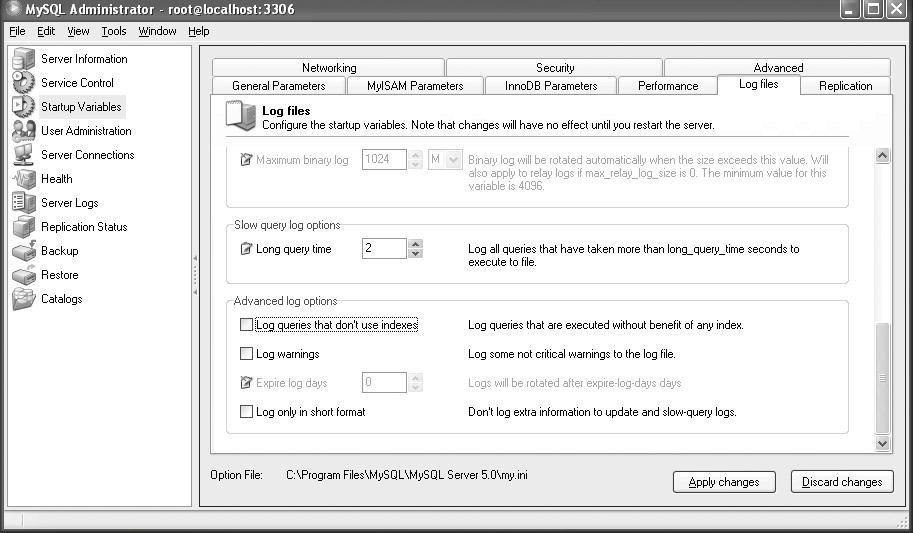
The binary character set is the character set for binary strings, which are sequences of bytes. The binary character set has one collation, also named binary. Comparison and sorting are based on numeric byte values, rather than on numeric character code values (which Mysql appends a numeric extension to the binary log basename t o generate binary log file names, mysql binary option. The number increases each time the server creates a mysql binary option log file, thus creating an ordered series of files. If you want to write the binary log files to a different directory then specify the basename with a In this case, invoke mysql with the --binary-mode option. You can also redirect the output of mysqlbinlog to a text file instead, if you need to modify the statement log first (for example, to remove statements that you do not want to execute for some reason)


No comments:
Post a Comment